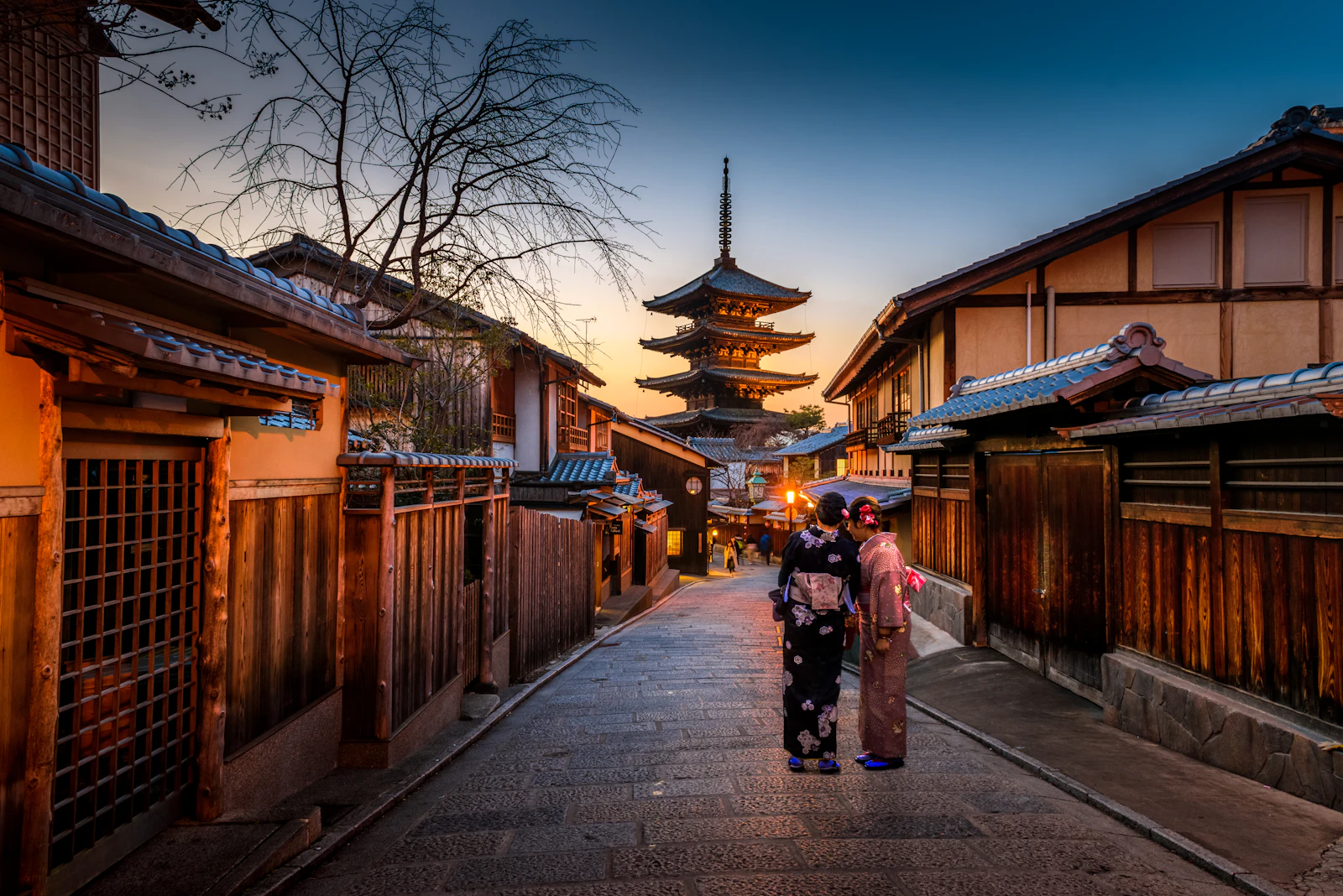
Japan: temple lanes, mountain baths and gardens
Tokyo, Hakone, Kyoto and Kanazawa by rail, with a private bath in the mountains and time to explore on foot
You begin beside the Sumida River and in the lanes of Yanaka, then cross Tokyo with a private guide. In Hakone, sculpture and mountain transport fit around kaiseki dinners and your private open-air bath. Kyoto combines Higashiyama at dawn, a private tea ceremony and walks through bamboo and shrine gates. In Kanazawa, you explore Kenrokuen, former samurai lanes and museums before returning to Tokyo by Shinkansen.
Highlights
- Yanaka neighbourhood walk and an izakaya evening in Ebisu
- Private open-air bath and two kaiseki dinners in Hakone
- Higashiyama at dawn with a private guide
- Private Urasenke-style tea ceremony and a kaiseki dinner in Kyoto
- Kenrokuen and the teahouse lanes of Kanazawa
Tokyo
Heathrow to Tokyo
Your journey to Japan begins at London Heathrow, where you board a daytime nonstop flight to Haneda with JAL, ANA or British Airways. The flight takes approximately 13 hours 50 minutes, with the night spent on board and arrival planned for tomorrow morning. Travel down from Edinburgh separately, leaving room in your arrangements for the Heathrow departure. We recommend having breakfast before boarding and keeping a warm layer within reach, so that your main bag can stay closed once you settle into your seat.
Before leaving home, complete Visit Japan Web and save the arrival details where you can find them easily. It is an optional preparation step, and the QR code belongs with your passport and travel documents in your hand luggage. Your itinerary includes a Welcome Suica Mobile setup guide: work through it on a compatible iPhone before departure, while you have a familiar connection and access to your payment cards. Keep a separate payment method available for local travel and purchases.
Pack walking shoes you already find comfortable, layers for the cooler evenings in Kyoto, and a light raincoat for Kanazawa. A small bag will accompany you to Hakone while your main cases travel ahead to Kyoto, so put that inside your suitcase now. We recommend keeping medication, charging cables, travel documents and a change of clothes in your cabin bag. Leave some space around anything fragile that you might bring home.
Once on board, set your watch to Japan time, which is nine hours ahead of the UK in November. Look through the arrival instructions and the address of your Nihonbashi hotel, then put the documents away. Tomorrow's programme begins with a luggage drop and an easy walk in Asakusa; there is no timed attraction to hurry towards after landing. You can have something to eat near the hotel before going out, and the first evening is deliberately free for an early night.
Good to know: Welcome Suica Mobile is intended for compatible iPhones; the setup guide includes an alternative payment plan if your device or card is unsuitable. Your exact flight and baggage allowance will be specified with the fare.
Flight London Heathrow – Tokyo Haneda
London Heathrow (LHR) → Tokyo Haneda (HND)
Daytime nonstop with JAL, ANA or British Airways, about 13 h 50 in the air plus nine hours of time difference, so you land on the morning of day 2. Economy, baggage per fare. Seats and exact times confirmed with the booking.
First steps beside the Sumida
You arrive at Haneda this morning and travel into Tokyo after collecting your luggage. The Keikyu journey to Shinagawa takes approximately 15 minutes; the onward journey to Nihonbashi comes afterwards. A taxi is an alternative if you prefer to keep your bags with you for the whole transfer. At the boutique hotel, leave your cases and take out only what you need for the afternoon. We recommend a meal nearby before setting off for Asakusa, with time to sit down after the flight.
Approach Senso-ji through Nakamise, where shopfronts line the route towards the temple. Rice crackers, small cakes and souvenir displays give you reasons to stop without planning a shopping expedition. Look up from the stalls towards the red lanterns and broad temple roofs, then move into the grounds. Around the incense burner, smoke can drift across the courtyard while visitors pause before approaching the hall. Stand to the side to watch the movement between gate, courtyard and steps.
The temple grounds remain accessible throughout the day, so you can let the walk follow your energy rather than an appointment. Senso-ji's main hall has a shorter visiting window, from 6:30 to 17:00 in this season. If you would like a snack, choose something at a stall and eat where the vendor indicates before continuing. There is no need to work through the whole shopping street; a short look at the stalls and a circuit of the courtyard are enough for this first outing.
Afterwards, walk towards the Sumida River. The view opens out beside the water, with bridges spanning the river and the Tokyo Skytree rising beyond the buildings on the opposite side. Follow the riverside for as long as you feel comfortable, then turn back towards your transport home. Sitting beside the river is a good alternative to extending the walk. Return to Nihonbashi, collect your bags and settle into your room. For dinner, we recommend staying near the hotel and leaving tomorrow's Yanaka walk until after breakfast.
Good to know: The short airport rail time is to Shinagawa, not to your hotel; onward travel takes additional time. Tsukiji is left out today because the outer market is closed on Sundays.
Haneda to your hotel
Tokyo Haneda (HND) → Nihonbashi, Tokyo · 21.8 km · 49 min
Keikyu line to Shinagawa in about 15 minutes, then a short taxi to Nihonbashi; or a taxi straight from the terminal. Luggage can be left at the hotel before check-in.
Asakusa: Senso-ji and Nakamise
A gentle first afternoon: the Kaminarimon gate, the Nakamise lane of snack and craft stalls, the main hall and pagoda of Senso-ji (grounds open all day, hall 6:30–17:00, free), then the Sumida riverside towards Azumabashi bridge.
First evening: early dinner near the hotel
Soba or tempura counter a few streets from the hotel, then sleep. Jet lag is easier if you stay awake until about 21:00 local time and get morning daylight on day 3.
Yanaka lanes and an evening in Ebisu
After breakfast, head to Yanaka for a morning on foot. Low houses, temple entrances and small plots of greenery sit along its quieter lanes; bicycles lean beside doorways, and pots narrow the space between a front wall and the street. Start with a walk past the temples, stepping into an accessible forecourt if you would like to look more closely. From the lane, tiled roofs and wooden gates often give only a partial view of what lies inside. We recommend walking without headphones here, so that you can hear approaching bicycles on the narrow streets.
Continue towards Yanaka Ginza, where food shops and everyday shopping bring a different rhythm to the morning. At the steps above the shopping street, pause to look along the roofs and signs before walking down. Fried snacks, vegetables and household goods share the shopfronts; choose something to eat if you are hungry, or stop for a drink. Ask before photographing a shopkeeper or a display at close range, and keep the entrance clear while you decide what to buy.
From Yanaka, continue towards the edge of Ueno Park. The wooded paths offer a place to stretch the walk after the shopping street, with room to stop beneath the trees. Look at the leaves overhead and those already on the ground: the mix may still include plenty of green. Today is planned around the neighbourhood and park rather than museum interiors, leaving you free to return to Nihonbashi for lunch and a rest whenever you are ready.
In the evening, travel to Ebisu for an izakaya meal. We recommend choosing a place with a menu you can comfortably discuss, then ordering a few dishes to share before deciding whether you want more. Grilled skewers, tofu or a plate of vegetables make useful starting points, depending on the kitchen. An izakaya evening works well at the table: you can keep ordering as you talk, without treating every dish as a separate course. Afterwards, return to your hotel and prepare for tomorrow's earlier start at Meiji Shrine.
Good to know: Many museums close on Mondays; today's route keeps to streets and park paths. No tipping is expected at dinner.
Yanaka morning walk
Temple lanes and wooden houses that survived the war, Yanaka cemetery under old cherry trees, then Yanaka Ginza shopping street for a snack. Ends at the edge of Ueno park.
Evening in Ebisu: izakaya
Counter seats in one of the small izakaya under the tracks; order a few plates at a time. We can reserve one if you prefer.
Shrine woods, city crossings and moving light
Meet your English-speaking private guide for a day across Tokyo, beginning at Meiji Shrine when it opens at sunrise. The broad approach passes beneath wooden torii and into trees, with gravel underfoot and the city gradually screened by the trunks. At the shrine courtyard, let your guide explain the gestures you see before deciding whether to join in. You can also stand back and watch visitors approach the offering area. Beginning here leaves room for questions before the busier streets later in the day.
Walk out towards Harajuku and continue along Omotesando. The scale changes from the shrine approach to shop windows, façades and avenues; ask your guide to point out the details of a building that catches your eye. We recommend a coffee stop along the way, then lunch before the afternoon's ticketed visit. If browsing appeals, use this stretch for it rather than adding another shopping district. You will have time in Tokyo again before flying home.
At Shibuya, cross with the pedestrians when the lights change, then find a place clear of the flow to look back. The crossing is easiest to understand from its edge: several streams of people meet, spread across the road and separate at the opposite kerbs. Afterwards, travel to Azabudai Hills for teamLab Borderless at your reserved entry time. Within the digital installations, projected images move across surfaces and between spaces; stay with a work long enough to see it change before moving on. Your ticket is for Borderless, at Azabudai Hills.
Tsukiji Outer Market is an alternative morning if food interests you more than the shrine and shopping streets. We would reshape the guided route around that choice, keeping the teamLab reservation as the afternoon anchor. In the market, look for fish counters, dried ingredients and utensils, and have a small breakfast as you browse. Back in Nihonbashi this evening, separate the clothes you need for Hakone from the cases going ahead to Kyoto, and keep tomorrow's Romancecar reservation within reach.
Good to know: Tsukiji replaces part of the morning programme and is closed on Sundays and Wednesdays, with individual shop variations. teamLab requires a timed ticket; the guide's route will be arranged around it.
Meiji shrine at opening, Harajuku and Shibuya
The forest approach to the shrine at opening (sunrise), free; then Omotesando's tree-lined avenue and the Shibuya crossing. Shibuya Sky is optional (¥3,000 before 15:00, timed ticket).
teamLab Borderless, Azabudai Hills
Timed entry ticket included. Plan about two hours; wear shoes you can walk in on mirrored floors.
Into Hakone with a smaller bag
Leave your main suitcases with the Nihonbashi hotel for takkyubin forwarding to Kyoto, taking a smaller bag for your stay in Hakone. Include clothes for both nights, toiletries and the things you will need until you meet the cases again. Keep passports, medication and valuables with you. Delivery on the Tokyo–Kyoto route is usually the next day, allowing the cases to arrive ahead of you; the receiving hotel details and luggage labels form part of your travel arrangements.
Travel to Shinjuku for the reserved Romancecar to Hakone-Yumoto, a journey of approximately 80 minutes. Once seated, put the small bag away and watch the dense city frontage begin to loosen into lower buildings and more open stretches. We recommend eating before the onward journey into Hakone, leaving the afternoon free for the ryokan. Your included Hakone Free Pass covers the planned local sightseeing transport during its validity; your travel documents distinguish the pass from the separately reserved Romancecar service.
Continue to the ryokan and plan to arrive between 15:00 and 17:30. This leaves time for the usual arrival formalities, an explanation of the room and a bath before dinner. At a ryokan, you usually remove outdoor shoes at the entrance and may be shown where to leave slippers before stepping onto tatami. Follow the host's lead as you settle in. Put tomorrow's walking clothes aside and keep the rest of the evening's belongings within reach.
Your private open-air bath is the reason for staying here as well as the food. Wash before entering, then settle into the water and notice the cooler air on your shoulders. Afterwards, dry off and change for dinner at the agreed time. Kaiseki usually arrives as a succession of small dishes, with different bowls and plates setting off each preparation. Look at the shape of the serving dish as well as the ingredients; a covered bowl may hold a clear broth, while another course arrives grilled or simmered. Ask your host about anything unfamiliar, and leave the following morning's route until after dinner.
Good to know: The two-day Hakone Free Pass is planned for 11–12 November; the departure transfer on 13 November is ticketed separately within the rail plan. Send dietary requirements before the ryokan stay so that the dinner arrangement can be addressed in advance.
Boutique hotel in Nihonbashi
Double room with breakfast, three nights. Small house on a quiet side street between the old merchant district and Tokyo Station, ten minutes on foot to the Ginza line. Sample trip: property type, not...
Hakone
Ryokan and Mount Fuji
Two nights at a kaiseki ryokan with private open-air bath. Mount Fuji on a clear day; otherwise the lake, the open-air sculpture park, and a long soak.
Luggage forwarded Tokyo → Kyoto
Nihonbashi, Tokyo, Japan → Gora, Hakone, Japan
Takkyubin (Yamato) from the hotel desk, arrives the next day in Kyoto. You travel to Hakone with an overnight bag only.
Romancecar Shinjuku → Hakone-Yumoto
Nihonbashi, Tokyo, Japan → Gora, Hakone, Japan
Odakyu Romancecar, about 80 minutes, all seats reserved. Hakone Free Pass for two days covers the Tozan railway, cable car, ropeway, Lake Ashi boat and buses.
Sculpture, the mountain railway and Lake Ashi
After breakfast at the ryokan, begin at the Hakone Open-Air Museum, which opens at 9:00. Sculpture stands across sloping lawns, with trees and the surrounding hills forming the background. Walk around a piece that interests you, noticing how its outline changes as the open space behind it gives way to a wooded slope. The outdoor setting rewards moving slowly between works. We recommend keeping the morning here focused, leaving room for the mountain transport and a return to your bath before dinner.
Continue by the Tozan railway and cable car towards the ropeway. The railway climbs through wooded slopes, and its changes of direction make the gradient more noticeable than it appears on a map. On the ropeway towards Owakudani, the view can open over a much barer landscape, with steam rising from the volcanic ground. Stay in the designated visitor areas when you leave the transport. The day's interest is in the changing terrain as much as any single viewpoint.
(Please note: Volcanic activity, gas alerts or strong winds can suspend the ropeway; use the replacement bus between Sounzan and Togendai when provided, or shorten the circuit if services are restricted.)
From Togendai, continue onto Lake Ashi by sightseeing boat. Wooded shores frame the water, and the view changes as the vessel passes the folds of the hills. Take a seat inside if the air feels cold, then step out for a look when you wish. A clear view of distant mountains would be a bonus. After the crossing, visit Hakone Shrine, where the approach beneath tall trees leads towards the shrine buildings and the lake sits below the wooded hillside.
Return by the local route set out in your rail plan, allowing time to change before the ryokan's dinner. If the museum holds your attention or transport takes longer, we recommend shortening the lakeside walk. Back at your room, put damp outer layers aside and bathe while there is still time to sit afterwards. This evening's kaiseki gives you another chance to ask about the dishes and their presentation, with no onward journey until tomorrow.
Good to know: The Open-Air Museum is open 9:00–17:00; admission is ¥1,600 per adult, payable on the day. Keep a warm layer in your day bag for the boat and higher ground.
Hakone Open-Air Museum
Sculpture park on the hillside, 9:00–17:00, ¥1,600 per person, foot bath at the end. One stop from Gora on the Tozan railway.
Ropeway to Owakudani and Lake Ashi
Cable car from Gora to Sounzan, ropeway over the volcanic valley to Owakudani and down to Togendai, boat across Lake Ashi to Moto-Hakone, Hakone shrine on the lakeshore. Covered by the Free Pass. (Please note: the ropeway can close at short notice for volcanic gas; a replacement bus runs Sounzan–Togendai.)
To Kyoto, then an evening around Gion
After breakfast, leave the ryokan for Odawara by the local railway and bus route appropriate to its location. Your reserved Hikari Shinkansen then takes you to Kyoto in approximately two hours. Bring something to read and keep a drink beside your seat; with the main cases already forwarded, the station changes should be easier to manage. The train journey is the main appointment this morning, so we recommend continuing directly to the hotel after arrival rather than adding a stop near Kyoto Station.
At your machiya-style boutique hotel in Higashiyama, collect the forwarded cases and unpack for your stay. You have several mornings here, with time to return between outings. After a pause, head towards the edge of Gion, following the public streets. Timber façades, latticework and fabric curtains over doorways give you details to notice at walking pace. On Hanami-koji, look along the line of the buildings before continuing, allowing people entering and leaving the premises to pass.
Keep to streets open to visitors and respect barriers and signs at side lanes. Private alleys in parts of Gion are closed to tourists, and breaches of the access or photography restrictions can incur a ¥10,000 fine. We recommend photographing the streetscape where permitted and leaving people going about their work undisturbed. There is no arranged encounter with a geiko or maiko. Have dinner nearby before deciding whether to continue to Kodai-ji for the proposed illumination visit.
At Kodai-ji, the planned evening focuses on the garden after dark. Lit trees and their reflections in the water can make the spaces between the branches as noticeable as the leaves. Follow the visitor route and stop clear of the path when you want to look for longer. Last autumn's schedule was 17:00–22:00 with admission of ¥600; we will confirm this year's dates. If the event is unavailable, finish with your Gion walk and return to the hotel. Tomorrow begins early in Higashiyama, so we recommend leaving any further evening exploring for another day.
Good to know: Kodai-ji's illumination hours and admission are last year's reference, pending the 2026 programme. Any case carried on the Hikari that meets the oversized-baggage threshold of 160 cm in combined dimensions needs a luggage reservation.
Kaiseki ryokan with private open-air bath
Two nights half board: kaiseki dinner and Japanese breakfast, tatami room with its own open-air bath on the terrace. Check-in from 15:00, arrival by 17:30 recommended; dinner usually 18:00–19:30. Samp...
Kyoto
Higashiyama, Arashiyama, and a tea ceremony
Four nights in Kyoto: temples in Higashiyama at dawn, the Arashiyama bamboo grove before the crowds, and a private tea ceremony at Urasenke. One day kept free for Nishiki market or a walk to Fushimi Inari.
Tozan railway and Shinkansen Odawara → Kyoto
Gora, Hakone, Japan → Higashiyama, Kyoto, Japan
Tozan railway down to Odawara, then Hikari on the Tokaido Shinkansen, about two hours, reserved seats. Your suitcases are already at the hotel in Kyoto.
Kodai-ji autumn illumination
Evening opening 17:00–22:00 (last entry 21:30), ¥600. The maples over the pond are lit from below; the bamboo grove behind the temple is on the way out.
Higashiyama before the shop shutters rise
Meet your English-speaking private guide for an early start in Higashiyama, beginning at Kiyomizu-dera from 6:00. The temple's wooden stage projects from the hillside on a framework of tall supports, with the city beyond the trees. Look first at how the building sits against the slope, then follow the visitor route for another view of the structure. Your guide can place the temple within Kyoto's religious life while you have time to look, before the day's busier flow of visitors develops.
Continue down through Sannen-zaka and Ninen-zaka. Stone paving and steps run between timber shopfronts, with hanging curtains and signs tucked beneath the eaves. Before many shops open, the shape of the streets is easier to see. Stop at a wider point and look back uphill: the roofs overlap, and the steps partly hide the next stretch of lane. This is a useful moment for photographs without lingering in a doorway. Afterwards, pause for breakfast or something warm, according to the hotel's arrangements for your early departure.
Walk on towards Yasaka Shrine, where gates and lanterns bring you into another part of the district. Ask your guide about the difference between the temple you visited first and this shrine. We recommend sitting down for lunch before continuing north for the Philosopher's Path. If you would prefer a longer hotel rest, shorten the afternoon walk and give the morning your attention. The route can be adjusted with your guide around your pace.
Along the Philosopher's Path, a canal runs beside the footpath, with small bridges and houses breaking up the line of trees. Follow a section towards Eikan-do and notice how the view changes at each crossing. The leaves may be turning, though green foliage can still be part of the scene. An Eikan-do illumination is an option only if it has started; last year's season began on 15 November, so it is not assumed for tonight. Finish with the daytime visit or walk, then return for an evening near the hotel and dinner wherever appeals.
Good to know: Kiyomizu-dera admission is ¥500 per adult; the dawn visit is intended to ease the Saturday crowds. Eikan-do's evening opening remains conditional on the 2026 schedule, with no illumination ticket included.
Higashiyama at dawn: Kiyomizu-dera, Ninen-zaka, Sannen-zaka
Kiyomizu-dera opens at 6:00 (¥500); the wooden stage over the valley and the lanes below are quiet for about an hour. Down through Ninen-zaka and Sannen-zaka to Yasaka shrine before the shops open. (Please note: the private lanes of Gion are closed to visitors, fine ¥10,000; the main streets are open.)
Philosopher's Path and Eikan-do
Afternoon walk along the canal from Nanzen-ji towards Ginkaku-ji. Eikan-do is the maple temple of Kyoto; its evening illumination usually starts in mid-November, so it may just have begun.
Tea, Nishiki and dinner in Kyoto
After breakfast, make your way to a private Urasenke-style tea ceremony. Your host introduces the utensils and guides you through the preparation and drinking of matcha. Watch the cloth fold around a utensil, the whisk move through the tea, and the bowl turn in the host's hands. We recommend asking about a movement that interests you while leaving room to observe the sequence. You do not need to know the gestures beforehand; follow the explanation and handle the bowl as your host demonstrates.
Tea is often accompanied by a small sweet, whose texture and sweetness sit alongside the bitterness of matcha. Look at the bowl before drinking: its weight, glaze and shape are part of the experience. A private session gives you space to ask questions together and to discuss the seating arrangement in advance if kneeling is uncomfortable.
Continue to Nishiki Market for a walk beneath the covered arcade. Pickles appear in trays and jars, dried ingredients hang or lie stacked at counters, and some shops display knives and kitchen utensils. Look for the difference between something ready to eat and an ingredient intended for cooking at home. If you would like lunch here, choose a few small things and eat at the places indicated by the vendors. We recommend keeping lunch light, with your kaiseki reservation planned for this evening.
Return to Higashiyama for a rest rather than adding another temple. Later, go to the restaurant reserved for your Kyoto dinner. Kaiseki gives the evening a sequence of preparations: perhaps a clear soup, a grilled dish and a simmered course, each served in its own vessel. Compare the presentation with your ryokan dinners and ask about an ingredient you have seen at Nishiki. The restaurant determines the menu, and your dietary requirements should be part of the reservation request. Afterwards, return to the hotel and lay out comfortable shoes for tomorrow's early visit to Arashiyama.
Good to know: Nishiki's general visiting window is approximately 9:00–18:00, with individual shop hours; the Kyoto dinner is reserved by us one to two months ahead. The reservation and the set menu are included, drinks are payable on the evening.
Private tea ceremony
About an hour in a tea room with a licensed host: the etiquette of the guest, whisked matcha, a seasonal sweet. Included in the price.
Nishiki market and a slow afternoon
Covered market street, 9:00–18:00, pickles, grilled skewers, knives, tea. Sunday is busy; go around noon and leave the afternoon free.
Kaiseki dinner in Kyoto
Multi-course seasonal dinner at a counter or in a private room, reserved by us one to two months ahead. Included in the price; drinks extra.
Bamboo at dawn, shrine gates before dusk
Leave Higashiyama early for Arashiyama and begin in the bamboo grove at dawn. The stems rise close together on either side of the path, with joints marking their height and leaves meeting overhead. When the air moves, you may hear the canes and foliage brush against each other. Walk through before stopping for photographs at a place where others can pass. Looking upwards gives a different sense of the grove from the familiar view straight along the path, especially where daylight filters through the canopy.
The grove is freely accessible, while nearby Tenryu-ji opens at 8:30. Have breakfast before the garden visit, arranging your early departure from the hotel accordingly. At Tenryu-ji, follow the route beside the pond and look at the placement of rocks, trees and the hillside beyond. From one point, the garden may seem to end at the water; from another, the wooded slope becomes part of the view. We recommend taking the garden at a slower pace after the bamboo walk, then having lunch before travelling back across Kyoto.
Leave the middle of the day for a rest. In the late afternoon, head to Fushimi Inari and follow the torii-lined route uphill towards Yotsutsuji. The vermilion gates form repeated frames around the path, with dark lettering on their uprights. Turn occasionally to see how different the same stretch looks in the opposite direction. As the route climbs, flights of steps and gaps between the gates interrupt the corridor, with smaller shrine areas beside the way.
At Yotsutsuji, pause for the view over Kyoto before returning by the signed route. We recommend starting the climb while daylight remains and turning back earlier if you want a shorter walk; reaching the junction is an intention, not an obligation. The shrine grounds are accessible around the clock, but that does not extend the daylight available for the walk. Back at your hotel, pack for Kanazawa and set aside what you need while your main cases are in transit. Dinner can stay simple after a day with plenty of walking.
Good to know: Tenryu-ji's garden is open 8:30–17:00 and costs ¥500 per adult; Fushimi Inari is free to enter. Bring a light for the return path if you expect to remain beyond daylight.
Arashiyama early: bamboo grove and Tenryu-ji
Train to Saga-Arashiyama and into the bamboo grove before 8:00, then Tenryu-ji garden at opening (8:30, ¥500) with the pond and the hills behind in colour. Togetsukyo bridge on the way back.
Fushimi Inari in the late afternoon
Open all hours, free. Walk up through the torii gates to the Yotsutsuji viewpoint, about 40 minutes up, and come down as the lanterns are lit.
Through Tsuruga to Kanazawa
After breakfast, leave your cases for forwarding from Kyoto to Kanazawa and take your overnight essentials with you. Keep the destination address and luggage receipt in your travel folder, along with the rail reservations. Today's journey begins on the Thunderbird to Tsuruga, where you change to the Tsurugi Shinkansen for Kanazawa. The combined rail journey takes approximately two hours. Follow the transfer signs at Tsuruga with your smaller bag, then settle into the reserved seats for the next part of the trip.
We recommend having lunch before setting out to explore Kanazawa. At the boutique ryokan near Higashi Chaya, drop your bag and take a raincoat or umbrella for the afternoon. November here is wet enough that a covered stop should be part of the day's rhythm. An umbrella also makes it easier to keep walking between showers without returning to the room each time. Leave room in the afternoon for a café or tea break, especially if you have spent the morning looking out from the train.
In Higashi Chaya, wooden lattice fronts line streets of former teahouses. Some buildings open as shops or visitor interiors, while others remain private; begin by walking the public lanes and looking at the façades. The repeated vertical slats screen the rooms from the street, so the buildings reveal more through proportion and texture than through open windows. After rain, the paving darkens and the grain in the timber stands out beneath the eaves. Stop where the lane widens to look back along the fronts.
If you would like to browse, look for local craft displays, including lacquerware and gold-leaf work. Choose an open shop that interests you and ask about how a piece was made; a purchase is optional. We recommend handling delicate items only when invited, particularly bowls or objects with fine surfaces. Finish with tea or a warm drink before returning to the ryokan. For dinner, choose somewhere nearby and leave Kenrokuen for the morning, when you can give the garden your attention before continuing across the city.
Good to know: The Thunderbird no longer runs through to Kanazawa; the change at Tsuruga is part of the booked journey. Kyoto–Kanazawa luggage delivery is next-day, so your small bag should cover an overnight wait.
Machiya-style boutique hotel in Higashiyama
Four nights with breakfast in a converted townhouse: wooden lattice front, inner garden, rooms with tatami and western beds. Kiyomizu-dera and Gion within walking distance. Sample trip: property type,...
Kanazawa
Luggage forwarded Kyoto → Kanazawa
Higashiyama, Kyoto, Japan → Higashiyama, Kanazawa, Japan
Takkyubin from the hotel desk, arrives the next day; carry an overnight bag.
Thunderbird and Tsurugi Shinkansen Kyoto → Kanazawa
Higashiyama, Kyoto, Japan → Higashiyama, Kanazawa, Japan
Limited express Thunderbird to Tsuruga (about 45 minutes), same-platform change to the Tsurugi Shinkansen, about two hours in total, reserved seats.
Higashi Chaya district
Afternoon in the lanes of wooden teahouses with their lattice fronts; one teahouse is open to visitors, gold-leaf shops and a sweet with tea. (Please note: Kanazawa has about 18 rain days in November; bring a folding umbrella.)
Kenrokuen, samurai lanes and quiet water
Begin in Kenrokuen, taking the early opening if it suits you or arriving during regular hours from 8:00. Paths lead between ponds, planted slopes and pine trees, with stone lanterns and bridges drawing the eye across the water. Stop at a pond edge and look for the reflection of a branch before following the path around it. In November's lower light, the shadows beneath the pines can stay dark while the open water catches the sky. Leaves may add colour, though the shape of the planting gives you plenty to see whatever the season's progress.
Continue to Nagamachi for a walk along the former samurai district's lanes. Earthen walls, tiled caps and narrow water channels mark the street edges, screening much of the housing from view. Notice the change from the shopfronts of Higashi Chaya to these more enclosed boundaries. We recommend enjoying the public lanes first and treating any house interior as an optional extra, so that the walk can finish when you are ready for lunch. Afterwards, choose somewhere to sit down before the museums.
For the afternoon, start with the 21st Century Museum of Contemporary Art. Its low circular building and extensive glass make the architecture part of the visit; the exhibitions add a change of scale after the garden and streets. Choose the displays that interest you rather than trying to see every room. If you prefer a longer visit here, shorten the morning's Nagamachi walk to keep the afternoon comfortable.
Continue to the D.T. Suzuki Museum before its earlier closing time. The spare rooms and reflecting pool invite a slower visit: at the water's edge, a ripple briefly breaks the straight line of a reflected wall. Sit quietly if a place is available, then read about Suzuki's thought at your own pace. Both museums are placed on Wednesday to avoid their usual Monday closures. Return to the ryokan, collect your forwarded cases and choose dinner in town before packing for tomorrow's journey back to Tokyo.
Good to know: Kenrokuen's regular hours are 8:00–17:00; the 21st Century Museum opens 10:00–18:00, and the D.T. Suzuki Museum 9:30–17:00, with last entry at 16:30. Use the shorter museum visit option if you want to include both without rushing.
Kenrokuen garden at early opening
One of the three great gardens of Japan, 8:00–17:00 in November, small entrance fee. The yukitsuri rope cones go up on the pines in November, the maples around the pond turn.
Nagamachi samurai lanes and D.T. Suzuki Museum
Earthen walls and canals of the old samurai quarter, then the quiet water-mirror courtyard of the D.T. Suzuki Museum (9:30–17:00, ¥310). The 21st Century Museum (10:00–18:00) is next door if the rain sets in.
Omicho Market and the train to Tokyo
After breakfast, leave your bags at the ryokan and visit Omicho Market before your train. Seafood counters give the morning its focus, with fish laid on ice, shellfish in trays and vendors preparing their displays. Walk through a few aisles before choosing where to stop; the market is a working place, so keep clear of deliveries and customers waiting at a counter. We recommend looking for a small meal or snack that appeals rather than booking a long lunch before the journey.
If you would like a seafood rice bowl, choose a counter or restaurant displaying what is available and ask about anything unfamiliar. Cooked dishes are an alternative if you prefer them. The visit also gives you a last chance to see ingredients close up after Kyoto's prepared kaiseki dishes. Buy food for immediate eating rather than something that needs to stay chilled through the rail journey. Leave enough room in the morning to return to the ryokan, collect the cases and continue to the station.
Board the reserved Kagayaki Shinkansen to Tokyo, a journey of approximately two hours 28 minutes. All seats on this service are reserved. Put anything you need during the journey in your smaller bag before stowing the cases, then settle down with a drink or your book. We recommend using the journey for lunch if you chose only a snack at Omicho. The market visit is kept flexible around this departure, with the station arrival time set out in your travel documents.
From Tokyo Station, continue to Shinagawa and your hotel near the Haneda line. Unpack only what you need for the last night. The evening is free: stay in Shinagawa for dinner, or go to Ginza if you would like to browse the department stores and shop windows. Ginza's wider streets and larger façades give this final outing a different feel from the lanes in Kanazawa. Return when you are ready and pack fragile purchases between soft clothes, leaving passports and flight details in your hand luggage for the morning.
Good to know: Omicho's stalls keep individual hours, so the morning visit follows what is open around your train time. Your reserved Kagayaki tickets are included.
Boutique ryokan near Higashi Chaya
Two nights with breakfast in a small ryokan on the edge of the geisha district: tatami rooms, a shared cypress bath, a courtyard garden. Sample trip: property type, not a real ryokan.
Tokyo, last night
Kagayaki Shinkansen Kanazawa → Tokyo
Higashiyama, Kanazawa, Japan → Shinagawa, Tokyo, Japan
Hokuriku Shinkansen Kagayaki, about 2 h 28, all seats reserved. Then Yamanote line to Shinagawa.
Omicho market in the morning
Crab, sweet shrimp and oysters on ice, a seafood rice bowl for breakfast at one of the counters before the train.
Haneda to Heathrow
Have breakfast at your Shinagawa hotel as your departure arrangements allow, then collect your cases for the journey to Haneda. Keep the smaller bag beside you while you make a final pass through the room: charging cables, the bathroom shelf and the bedside area are useful places to look. Put anything needed during the flight within reach before closing the main cases. We recommend leaving the morning free of sightseeing, so that breakfast, packing and the airport journey can follow each other without another appointment.
Walk to the station by the route in your travel documents and take the Keikyu service towards Haneda, following the instructions for your departure terminal. The rail section from Shinagawa takes approximately 15 minutes; the hotel departure is planned with separate time for the walk, airport formalities and any waiting. At the airport, keep passports and the flight reservation ready for check-in. Once the bags are handed over, you can put the luggage receipts with the other journey documents and continue towards departures.
Your daytime nonstop flight takes you from Haneda to London Heathrow, with arrival planned for the same evening. Japan is nine hours ahead of the UK in November, so the local arrival clock will look different from the time you have spent travelling. Once seated, change your watch back to UK time and keep a warm layer out for the cabin. Read, look through your photographs or have a meal when it is served; there is no further programme attached to this flight.
If you would like to sort your photographs, the rail journeys provide a useful order: Tokyo's streets, the bath and mountain transport in Hakone, Kyoto's temple approaches, and the garden and water in Kanazawa. Write down the name of a dish or place while it is still easy to remember. At Heathrow, collect your luggage and continue with your separately arranged journey to Edinburgh, or stay near the airport if that suits your plans. Your Japan itinerary ends at Heathrow this evening.
Good to know: The exact return flight and baggage allowance follow the booked fare; Heathrow arrival is planned for the evening of 20 November. Travel between Heathrow and Edinburgh is not included.
About this sample trip
Sample trip of the Tourvy demo workspace. The travellers and the consultant are fictional; hotels are property types, not real houses; images are AI-generated; prices are illustrative. Train times, opening hours and admission fees follow public sources as of September 2026.
Keikyu Shinagawa → Haneda
Shinagawa Station → Tokyo Haneda (HND) · 13.9 km · 31 min
About 15 minutes to Terminal 3.
Flight Tokyo Haneda – London Heathrow
Tokyo Haneda (HND) → London Heathrow (LHR)
Daytime nonstop, about 14 hours, arriving in London the same evening.
Hotel in Shinagawa on the Haneda line
One night with breakfast, a few minutes from the Keikyu platforms for the airport. Sample trip: property type, not a real hotel.
Services
Accommodations
12 nights- Boutique hotel in Nihonbashi3 nights08/11/26 - 11/11/26
- Kaiseki ryokan with private open-air bath2 nights11/11/26 - 13/11/26
- Machiya-style boutique hotel in Higashiyama4 nights13/11/26 - 17/11/26
- Boutique ryokan near Higashi Chaya2 nights17/11/26 - 19/11/26
- Hotel in Shinagawa on the Haneda line1 night19/11/26 - 20/11/26
Getting around
10 transfersExperiences
20 activitiesFor the whole trip
Excluded
Kiyomizu-dera ¥500, Tenryu-ji ¥500, Hakone Open-Air Museum ¥1,600, Kodai-ji illumination ¥600, museums in Kanazawa; all small and paid in cash or by card on the day.
Local transport in the cities is paid with Suica (about ¥3,000–5,000 per person for the trip). eSIM from about $10 for two weeks.
Not customary in Japan and not expected; service is included in prices.
Japan: temple lanes, mountain baths and gardens
- Dates
- 7 Nov 2026 – 20 Nov 2026 · 14 Days · 13 nights
- Travellers
- 2 Adults
- Valid Through
- 5 Oct 2026
- Payment terms
Happy with this trip?
No payment yet — your travel team first checks every availability and confirms your booking personally.
- 1You send your booking request
- 2We confirm availability and details
- 3You receive your booking code and payment link